The EV Charger Question Your Website Isn’t Answering
September 23, 2026 · 6 min read · Mesa Web Designers

In this article
A man buys an electric car. The dealer hands him the keys, a charging cable, and a cheerful sentence about how easy it all is. He drives home, opens the garage, and looks, for the first time in his life, at the gray metal door of the breaker panel.
He has one question. It is the question every EV buyer in the country eventually asks, and it is worth a great deal to whichever electrician answers it first: can my panel handle a charger?
Most electrician websites do not answer it. They list “EV Charger Installation” somewhere between “Ceiling Fans” and “Outlets,” as though the three were the same job, and invite him to call for a quote. He does not call. He keeps reading somebody else’s website.
What he actually needs to know
The answer comes in five parts, and none of them is a secret. Your site should say all five, in plain English.
- Level 1 or Level 2. The cable that came with the car usually plugs into an ordinary 120-volt outlet. That is Level 1, and it is slow — fine for a short commute, hopeless before a road trip on Monday. Level 2 runs on 240 volts, like a dryer, and it is what most owners end up wanting.
- The circuit. A Level 2 charger needs its own dedicated circuit. Because charging is a continuous load, the electrical code requires that circuit to be sized with headroom above what the charger draws — a charger rated at 48 amps needs a 60-amp circuit, not a 48-amp one.
- The panel. Whether there is room depends on what the house already draws, and an electrician answers that with a load calculation, not a glance. An older 100-amp panel feeding an electric range, a dryer, and central air may have no headroom left. A newer 200-amp panel often does.
- The alternatives. A full panel upgrade is not the only answer. Load-management devices and smart panels can share capacity between the charger and the rest of the house. Your customer deserves to hear that option exists before he is quoted the expensive one.
- The permit. Most jurisdictions require one for a new 240-volt circuit. Say so, and say you pull it. The homeowner who hears “permit” from you and silence from the other fellow has just learned something about the other fellow.
Code requirements vary by jurisdiction and by edition, and the load calculation belongs to a licensed electrician who has seen the panel. A website cannot replace that visit. It can make the homeowner want it.
Why answering it wins the job
An electrician who explains the continuous-load rule on his website has not given the job away. He has shown, before the phone ever rings, that he knows the job exists. That is rarer than it ought to be, and customers notice.
It also sorts the calls. The homeowner who read that his 100-amp panel might need help arrives expecting a real conversation, not a surprise on the invoice. The one with a newer 200-amp panel arrives ready to book. Either way, your dispatcher skips the first ten minutes.
And it answers the question that actually decides these jobs, which is not “how much” but “will this be a mess.” A page that explains the circuit, the panel, and the permit tells a homeowner the work will be done properly. That is what he is shopping for. The price comes second, whatever he says on the phone.
How to build it
- Give EV charging its own page. Not a bullet in a list. A page with the five answers above, written for the man standing in his garage.
- Help him read his own panel. Where the main breaker is, what the number on it means, what a useful photo shows. It turns a vague worry into a specific question he can bring to you.
- Offer a photo quote. A picture of the panel and the parking spot tells a good electrician much of what he needs to know. Let the homeowner send one before anybody rolls a truck.
- Name the chargers. People search for the charger they bought. A page that names the one in his cart is a page he stays on.
See it working — twice
We built a complete electrician homepage to show what a site like this looks like, for a company called Live Wire Electric. The company is fictional — we invented it for the demonstration. Its hero is a live dispatch board, with jobs landing on a map of the service area as the page loads, and its services are sorted by what a homeowner is actually looking at — EV chargers and panel upgrades among them — with flat-rate pricing in tabs he can compare.
Then there is the real thing. Bleuwave Electrical, a Phoenix electrician whose website we built, does exactly what this post recommends. EV charging has its own page, and it answers the questions in the order the homeowner asks them: Level 1 against Level 2, a load calculation on the existing panel, the right breaker and wire for the run, a permit pulled and an inspection passed. Then it names the chargers, with separate pages for the Tesla Wall Connector, Rivian, ChargePoint, Wallbox, Emporia, and universal J1772 units, because people search for the one they bought.
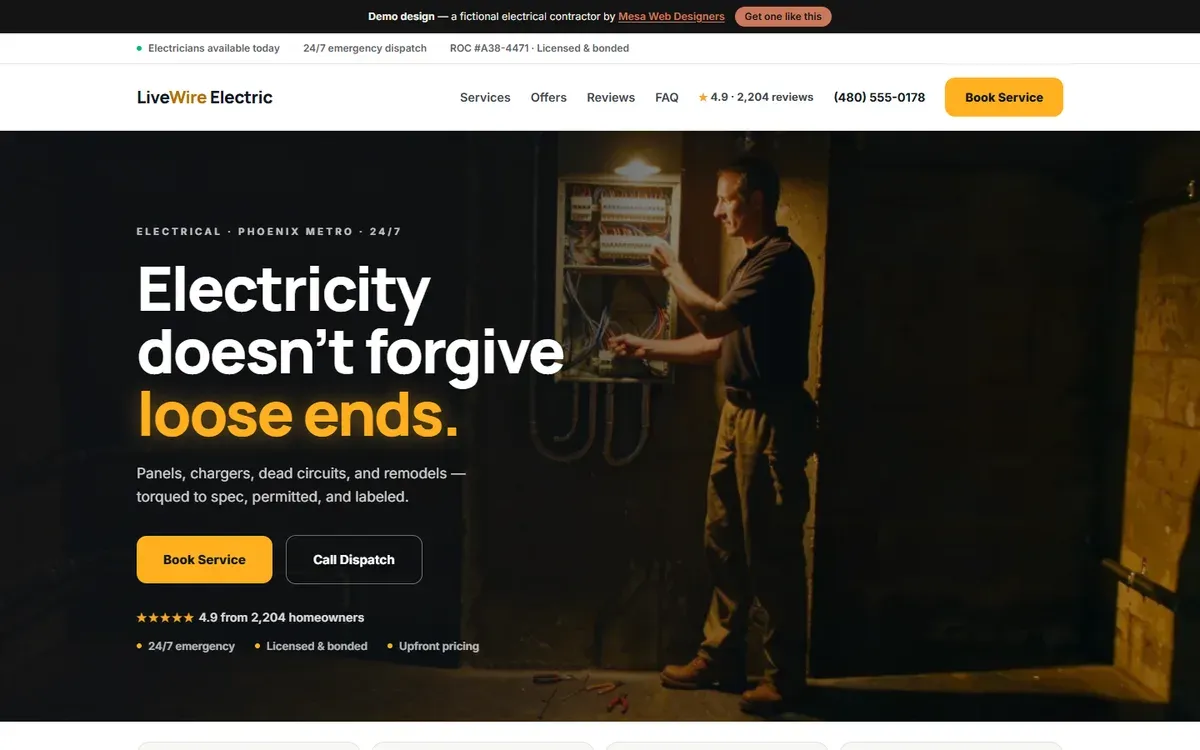
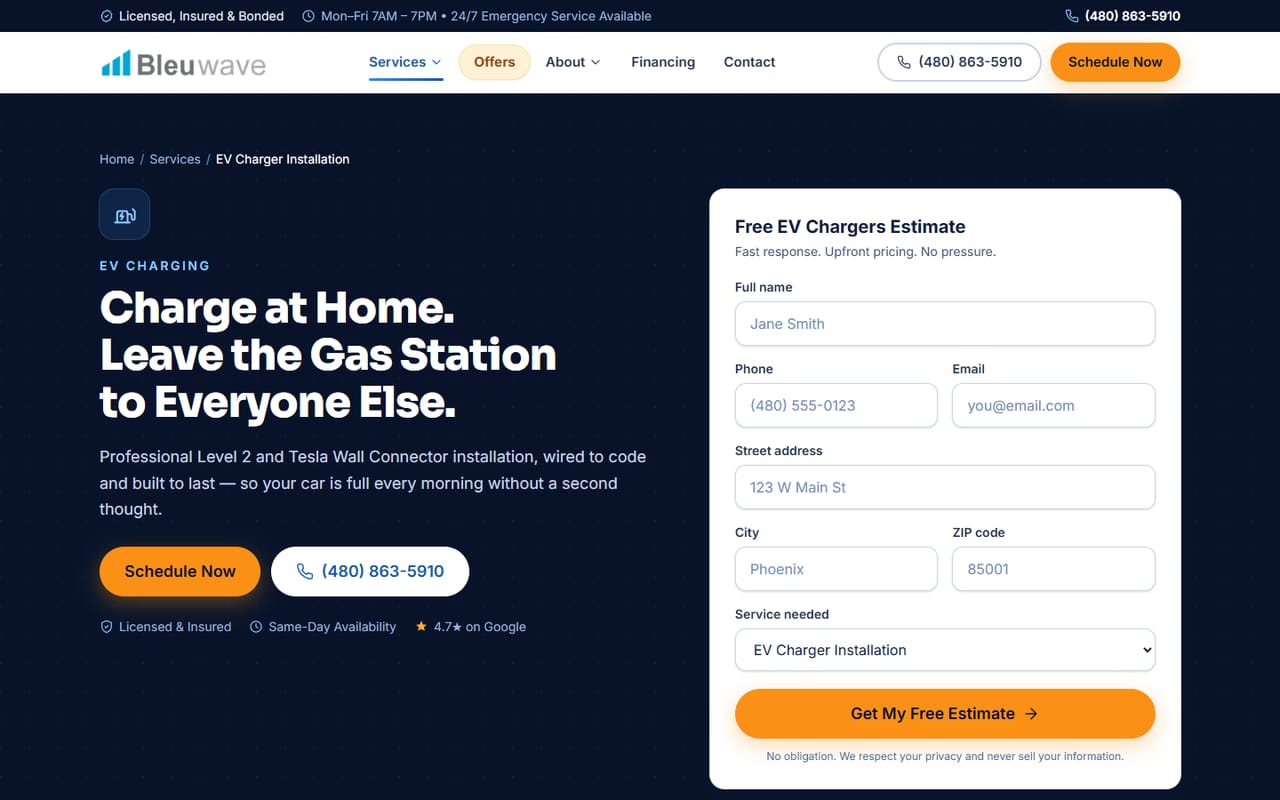
One is a demonstration. The other is a working business answering the man in the garage every day. The Bleuwave Electrical case study shows the rest of the build.
If your company should own this search
The EV buyers are already standing in their garages. Here is how we build electrician websites, and the prices are published.
Or tell us about your shop. We will tell you what your site should say to the man in the garage, and what it would cost to say it well.